

This is a follow-up to a previous article, called Why Is Lying Acceptable in Academia?
I have been following the Jason Arday case closely, and have written about it a few times now.
Why was anyone investigating him in the first place?
Some have argued that Arday was specifically targeted because of his race. Others have suggested that critics were motivated by politics, jealousy, or resentment of his success.
Those possibilities shouldn’t simply be dismissed. People really can be targeted for bad reasons, and that’s not okay.
But as someone who has spent years examining questionable research, I think there is another part of the process that is poorly understood:
How do people actually come to suspect plagiarism or research misconduct in the first place?
Sometimes investigators start with a person. Very often, though, they start with something much smaller: something doesn’t look right.
That observation itself is not proof of misconduct. But it can create reasonable suspicion, and reasonable suspicion is where investigation begins.
tl:dr:
People often imagine misconduct investigations as starting with a target. In reality, many start with an anomaly. Someone who knows the subject well sees something that does not make sense, checks it, and sometimes the evidence leads somewhere unexpected.
Here’s my detailed thoughts.
Reasonable Suspicion
Why did I become suspicous of Jason Arday?
Honestly, I didn’t know about Jason’s case until Steve Magness posted about Arday’s unbelievable running claims earlier in the week (August 3, 2026)


Magness knows running really well. As do I. As do many others who follow track and field.
When somebody makes an objectively measurable claim in an area you know well (in this case, running performance), you often have enough context to recognize immediately that something is unusual enough to warrant verification.
Let me give you an example…
Many years back, a woman I met (also in academia) told me that she was really fast. I asked about her times. She said she didn’t remember exactly, but knows she ran the 1500m under 4 minutes. I told her that would have made her a world-class 1500m runner (today, that would have put her in the top 200 all time list). She confidently responded “yeah, pretty much.”
What she didn’t know is that I was a track and field athlete myself, and understood the sport well. I said it was surprising to me that she ran such a fast time, yet I had never heard of her. She quickly downplayed it and stated that maybe she didn’t remember exactly because it was a long time ago, and changed the subject. I never did find out why she made this claim.
Someone unfamiliar with track might have heard “sub-four-minute 1500” and simply thought: Wow, she must have been really fast.
Someone who knows the sport hears something different: If that is true, this person should have been one of the best runners in the world. Why have I never heard of her?
That does not prove the person is lying… but it creates a legitimate reason to check.
I feel that is what happened with Jason. People that didn’t know about running trusted him. He said he ran 300 miles in 3 days, and 600 miles in 6 days, so people believed him.
But for those familiar with elite ultrarunning, his achievements sound much different. Those performances would place an otherwise little-known amateur athlete in extraordinarily rare company.
Now, that discrepancy alone does not prove dishonesty. But it absolutely creates reasonable grounds to ask whether the claims are accurate. It also must be realized that these were not obscure, one-off statements made privately years ago. Arday repeatedly incorporated extraordinary running accomplishments into his public biography and identity
Once someone chooses to make an objectively verifiable achievement part of their public story, verifying it is not “digging for dirt.” It’s basic fact-checking.
Scrutiny subsequently showed that at least some of those claims could not be sustained as originally presented. His 600 miles in six days became 600 miles across 12 elapsed days. The available evidence also raises serious questions about whether his planned 300-mile-in-three-days attempt was ever completed as later biographies claimed.
Why does that matter? Because once an objectively verifiable claim turns out to be materially inaccurate, it reasonably raises another question: are there other claims that should also be verified?
Prior behavior creates reasonable suspicion about a person
Back in my PhD, I worked with some people with big personalities. Very successful in research and medicine. And, one of their pathways to this was self-promotion - something that I mentioned a bit in an earlier essay.
As part of my PhD, I was assigned to doing golf research. It wasn’t my area of interest, but nonetheless, it was something I did.
Anyway, one of the prominent orthopedists (we’ll call him Dr. X) associated with the lab had a group of other orthopedists coming in to see the broader facilities, and he requested a weekened tour of our laboratory. I volunteered to do so. It was a typical tour, in which I had a few low-key demonstrations set up regarding our biomechanics equipment, such as 3D motion analysis. So, I showed the group an example of our 3D analysis of the golf swing.
One of the visiting orthopedists politely asked me and the host physician “Wow, this is cool. How much research on golf have you done?” or something to that effect. Before I could speak, Dr. X quickly answered “We publish 20 papers on golf every year.” The visitor replied “Wow, that’s impressive!”
And, indeed 20 papers on golf per year IS impressive.
But, it wasn’t reality.
In the lab’s entire history, guess how many papers it published on golf…
SIX.
Not 20 per year. Six total, across a decade.
At the time the visitor asked this question, they probably only had 3 published papers on golf.
Of course, the visitor didn’t know this. He walked away with the impression that we were some golf publishing powerhouse. And, he may have been so impressed that he told others about it. Who knows.
Was this an embellishment? An exaggeration? A lie? I don’t particularly care what we label it. The important point is that it was objectively untrue, and I knew it because I happened to possess information the visitor did not.
Fast forward 20+ years. Over the following years, I separately heard concerns from multiple people who had worked directly with Dr. X about behavior they considered unethical. And, I was already working in the field of research integrity, and had access to software that could detect image duplication.
So, I started looking into Dr. X’s work. And, indeed I found something highly suspicious in a paper he was on… but only one paper that he was on. So, I started looking into the coauthors on that paper… That’s where I found a pattern of blatant image manipulation.
I wrote that up in detail in June 2025. Here’s my full article:

In other words, I had reasonable suspicion that Dr. X was not being truthful in how he presented his work, based on my own experience and then stories from other reputable sources that worked directly with him. So, I further examined it - and found evidence of data manipulation by an entirely different person.
This is an important feature of misconduct investigations.
The original suspicion and the eventual finding do not necessarily involve the same person, or even the same problem.
I began by looking more closely at Dr. X because my own experience, combined with information from people who had worked with him, gave me reason to question whether his professional presentation was always reliable.
I found one suspicious paper. Following that evidence led me to the coauthors. And there I found a much broader pattern of image manipulation involving someone else. That wasn’t the conclusion I set out to prove, but it iswhere the evidence led.
Sometimes, that is the way people stumble upon reseearch misconduct or plagiarism. Yes, the investigation starts with a target, based on a reason, but then finds something else entirely.
The data themselves trigger suspicion
Some readers may be familiar with my investigation into the Q-collar. In brief, that is a jugular compresion device which supposedly “protects the brain” from impact. In 2025, I published a full-blown investigation about this device in The BMJ, which was also covered by the Washington Post. There’s a long backstory to it, but we found that the FDA didn’t have confidence that it actually worked, yet authorized it anyway.
Oh, and also, we found numerous data anomalies in the peer-review research supporting it. I’m not talking simple typos, but stuff like entire data tables meant to represent different studies copied-and-pasted, and mathematically impossible values. Six of those papers are currently labelled with a formal Expression of Concern, as they are being [slowly] investigated by the publisher’s research integrity team.
But, why did I start looking into the Q-collar in the first place? Did I have a personal vendetta against somebody associated with it? Was I jealous of something? Did I have a competing product?
Nope.
Something just didn’t sound right.
Back in 2013, a colleague asked me if I had seen a new study claiming there was a reduced risk of concussion at higher altitudes. When I found out that the altitude in question was 600 feet above sea level, I knew it didn’t make physiological sense. My colleague told me he agreed. I got another physiologist’ opinion, and he thought it made no sense also.
That was what triggered further interest, and started the pathway to an investigation that has gone on for over a decade.
Long story short, that altitude hypothesis was part of the scientific rationale for the idea that mild cerebral swelling might reduce brain movement within the skull.. and therefore that jugular compression might reproduce the purported protective effect… one of the authors just happened to have a patent for such a device.
My colleagues and I took action and started publishing articles about it to counter their claims. I’ll spare the details here, but it’s a long story with other claims that we have challenged.
But my point is this - it all started because something didn’t sound right.
Accidental Recognition
One way that people stumble upon plagirism is simply recognizing it.
As academics, we read a lot. What are we reading? Stuff that is relevant to our field of expertise. As academics, we are not only trained to know the content that we read, but also the authors of it. We speak in terms of “Smith et al reported…” and “Chau and colleagues wrote…” and such. We connect names with ideas and results.
So, when a new paper comes out, we’re likely to read it… and if something seems overly familair, perhaps too familiar, we may recognize it. Perhaps that will be “Wait a minute, I’ve read this before! This is the work of Lopez et al!” or maybe it will be something less obvious… But regardless, that is one way people find out about plagiarism. They specifically recognize it.
No software needed. Just a human brain saying “I’ve seen this before.”
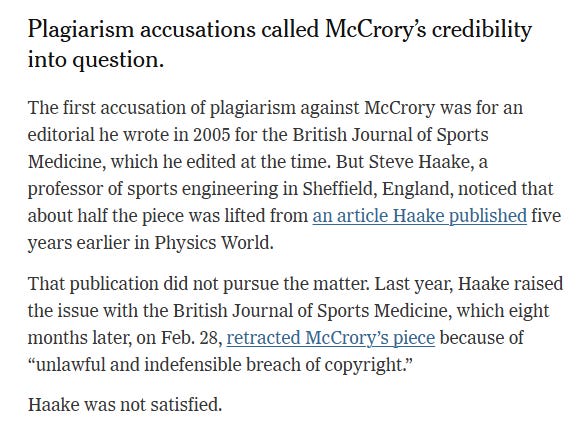
As a brief example, concussion expert Paul McCrory got caught this very way.
The New York Times describes it nicely in this screenshot below. Essentially, McCrory used professor Steve Haake’s work without attribution… And then Haake was reading McCrory’s work and recognized his own words!
I wrote about something similar back in January 2026. In brief, I was invited to serve as an external reviewer for a faculty member applying for promotion. And, in reviewing their documents, I immediately recognized that they were reusing somebody else’s course syllabus that I was very familiar with - right down to using the same assignments. And, they didn’t attribute where they got it from.
There’s more to the story than that, and I kept much of it anonymous, since the review itself was confidential (and I have done plenty of reviews), but you get the point - if we’ve seen something before, we can recognize it.
That is one way “re-use of material” originating elsewhere (without appropriate citation) can be found out - we recognize it.
Who First Raised Concerns About Arday’s Work?
Much of the current discussion around Jason Arday has focused on Nathan Cofnas - especially on whether Cofnas’s scrutiny was ideologically or racially motivated. He wrote an expose on the case on July 21, 2026. My link to his article is not an endorsement of any motivations of his statements, but provided for transparency and factual documentation that he has provided.
Motivations are a legitimate question about Cofnas. But it a completely different questions about how the concerns about Arday’s work first arose, and whether the claims were substantiated.
The earliest public concerns I have been able to document did not begin with Cofnas in 2026. Instead, they came from retired academic Dave Harris - who Cofnas does reference in his article. And how he found it was remarkably consistent with what I described earlier - he was reading Arday’s work with good intentions, and then found something that seemed amiss. That’s right, he stumbled upon them in the same manner that many cases like this begin.
This screenschot, timestamped from June 14, 2024 shows his concerns, and you can read them for yourself here.
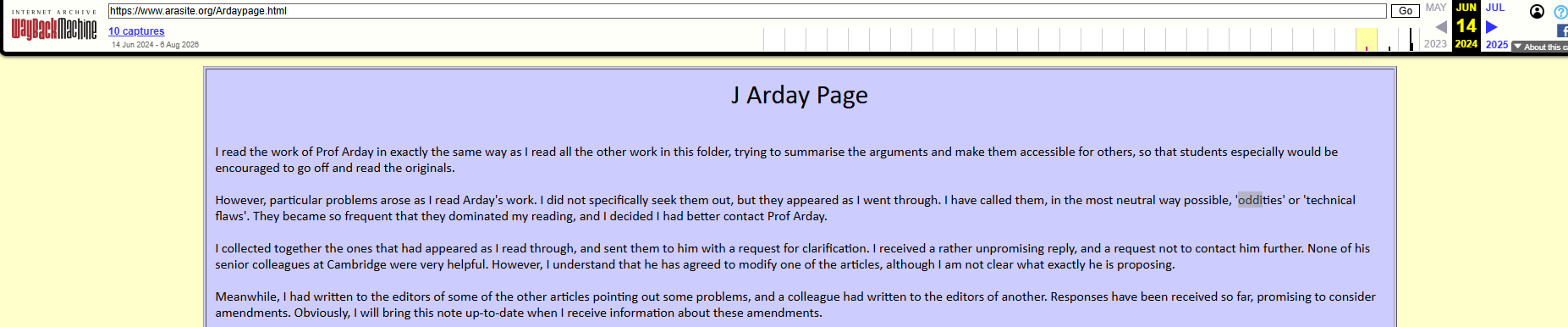
Harris says he encountered what he called “oddities” while reading Arday’s work in the ordinary course of trying to understand and summarize it. In other words, there was no obvious microscope trained on Arday from the outset. Harris was not, by his own account, conducting a campaign to investigate him. He was reading the scholarship, noticed things that did not seem right, and started asking questions.
That is exactly the kind of process I have been describing throughout this article: Harris seemed to have followed standard procedures in reporting concerns over anomalies to the journal. Something looked odd, began looking further, and then took action.
Harris then tried to address what he found through normal academic channels. He contacted Arday. He contacted journal editors. And importantly, this was all underway before the current controversy erupted. One of Arday’s papers received a substantial correction in December 2023, well before Cofnas became the public figure most associated with the allegations.
It means the simplest version of the story:
Cofnas targeted Arday and then went looking for misconduct
does not explain the origins of the concerns. I’m not making excuses for Cofnas’s ideology. I’m simply pointing out that he was not the person who first discovered or raised concerns about Arday’s work.
The concerns were already there! They had already been raised. A journal had already “corrected” one of the papers in 2023. But that didn’t necessarily resolve the problems.
Harris says that Arday asked him not to contact him further, that senior colleagues at Cambridge were “not very helpful,” and that journal responses were mixed: two editors or publishers requested corrections, while two others apparently concluded that the issues did not violate their professional guidelines.
This was not a single forgotten citation quietly inserted into one sentence. One correction added or clarified citations across the abstract, introduction, methods, multiple substantive sections, discussion, and conclusion, while acknowledging previously omitted overlap with earlier publications.
Reasonable people can disagree about whether correction rather than retraction was the appropriate remedy. But it is also reasonable to ask whether adding citations after publication fully addresses the more important research-integrity question:
How did a published paper come to contain that much unattributed or insufficiently attributed overlap in the first place?
There are actually two different questions here.
Is the published paper now corrected?
and
Why did the problem occur in the first place, and does the same problem appear elsewhere?
Those are not the same - a journal can successfully repair its own publication without determining whether the underlying problem was an isolated oversight, repeated carelessness, or part of a broader pattern.
In other words, a correction can repair the literature moving forward, but it does not necessarily explain the conduct that made the correction necessary or examine whether other issues remain unresolved. And, importantly, can provide reasonable cause to look into whether a broader pattern of such behaviour exists.
According to RetractionWatch, Times Higher Education was planning to publish a story on Arday, but it got pulled due to legal threats. One of the people involved was a research sleuth, David Sanders, who regulalry publishes about research misconduct. Sanders’s work regarding integrity has been publicly documented in many places previously - such as plagiarism and image manipulation in cancer studies, as documented in 2024 by UnDark.
Again, hiring a lawyer to defend oneself is not wrongdoing. People have every right to challenge reporting they believe is inaccurate or defamatory. But when legal pressure apparently contributes to a major news organization shelving an investigation based on a 63-page dossier, it is also reasonable to ask whether legitimate scrutiny is being chilled.
For people working in research integrity, this is an especially frustrating dynamic: evidence can exist, concerns can be legitimate, and yet the costs and risks of pursuing them can make the story effectively disappear.
It appears that it’s only in 2026 that Cofnas actually enters the story. Whatever one thinks of Cofnas’s motives, politics, or the racialized framing he later used in parts of his reporting, he was not creating the underlying concerns out of nothing. He was taking a set of existing concerns and broadening the scrutiny around them.
So we have four separate questions:
The origin of the ealiest concerns about Arday that I can document (Harris)
The adequacy of the initial response to allegations (publishers, university)
The motives of the person who later escalates it (Cofnas)
The truth behind the actual claims (Arday)
And this is one of the recurring dynamics in research integrity: problems often persist not because nobody notices them, but because the first attempt to resolve them does not fully settle the issue… and a broader pattern of issues then emerges.
So someone keeps looking, and then gets frustrated if the issues are not adequately addressed.
An unfair origin does not make accurate evidence disappear.
We’ve established the integrity of Arday’s work first came under question many years ago, and not by Cofnas.
But, let’s suppose, for argument’s sake, that the recent escalation of the investigation into Arday by Cofnas really did begin under reprehensible racist motives. That should matter, and the disciminatory treatment should be condemned.
But if the investigation nevertheless uncovers genuine plagiarism, misrepresented credentials, or other verifiable problems, we cannot simply discard that evidence because we dislike the motives of the person who found it.
Two things can be true at the same time:
The scrutiny or escalation may have begun unfairly.
The evidence uncovered may still be valid.
Confusing those questions creates a dangerous standard in both directions.
It can allow biased investigators to escape scrutiny for discriminatory behavior… and,
It can allow genuine misconduct to escape scrutiny because the wrong person discovered it.
Fairness requires more than choosing which side deserves sympathy - it requires us to examine both the process and the evidence.
Fairness should govern how we investigate. Evidence should govern what we conclude.
Previously Published in Part 1: Why Is Lying Acceptable in Academia? How academia embraces a culture of prestige, which incentivises spin, stretching the truth, and sometimes beyond…
Coming in Part 3: Solidarity Before Evidence — how reasonable suspicion should work and what happens when academics choose either solidarity or condemnation before the facts are mature.
If you’re interested in my other work on science, research integrity, sports, or longer-form essays, you can find links to those Substacks elsewhere. Always free!
Beyond the Abstract is where I write about science and research integrity. It’s the main place I write.
Human Limits is my section for sports science and related pieces… like this one.
Academic Life is about, well… life in academia.
Everyday Culture is about everything else… sometimes serious, sometimes funny.
This reminds me of faulty news reports in two very different fields where I have expertise.
For many years I was an engineer. I enjoyed reading news stories about engineering. For most of those, I was not deeply familiar with the topics of the stories, and I tended to believe the news. But a pattern emerged: when a story was about something I *did* know well, it invariably made some claim I knew to be false. I even met with one of the offending reporters. The reported was clearly more interested in selling stories than telling the truth.
Later I went into epidemiology, where my specialty is autism. Similar things happened. Both news stories and journal papers about autism epidemiology frequently contain claims that are at best not supported by the evidence.
That raises the question: what should one do about that? Writing to the editors and authors has generally not produced any meaningful corrective action. No matter whether the note is direct about the evidence or a very politely worded question, the result is the same. Going full bore publicly to address such problems might raise its own problems, as you alluded to in your piece here.
Speaking of things which just don't sound right ... I'm reading a book now by an author I enjoy, and at one point, it claims Japan imported 67 million tons of rice in 1940 or thereabouts, when its population was 70 million. One ton per person per year, in a country which grows a lot of its own rice. That's 3.6 pounds of rice a day. I flagged it (kindle). I don't think it's fraud or anything deliberate. Did they just drop a decimal point? Don't know. But it just doesn't pass the smell test, and it's the kind of thing a proofreader should have flagged.
ETA: The problem is not this one insignificant error, The problem is the doubt it sets up about other data of which I know nothing. Whether it is sloppy writing, data gathering, proofreading, or typesetting, it raises my brain's spidey sense. I have since found other lapses in the book, still all insignificant, and while the book is still interesting and worth finishing, it does make me read it with doubt in mind.